Thursday, October 6, 2011

Me, Myself and Masi


Summer is coming to a quick close which only means one thing... Amazing bike rides are here! Top of Ohio on my trusty Masi Special.

Red leaves and Tree covered roads down by Lillydale.


Yellow, red, green and orange. There is nothing like riding in the fall.

Thursday, August 11, 2011

Serial numbers are important!

Every year we hear about dozens of bikes getting stolen.  Many of these can be prevented, some of them can not but what always remains the same is that a serial number can help you get your bike back. 


Your serial number is usually placed on the underside of your bike frame (also known as the bottom bracket shell).  Flip your bike over, write it down, email it to yourself, be thankful you have it if your bike gets stolen.  If your bike does get stolen make sure to file a police report and give them your serial number, this will throw up a red flag if the thief tries to sell the bike to a shop (like ours) or any pawn shop.  It also gives you proof if you see it pop up on Craig's list that it is indeed yours.  If you see it pop up on craig's list then contact the police and let them take care of it.  This also holds true if you see it out in the real world, you need to remember that you probably really want to have your bike back but the thief wants to avoid getting captured even more. 

Keep your bike from getting stolen in the first place! A Kryptonite lock will keep your bike safe and warm, Locking skewers will help with the wheels staying on and the Abus chain lock is a flexible sub for a u-lock but not quite as secure.


Avoid Cable locks (example below) for any in-the-city locking.


Many times they can be cut faster than using a key or combo.


Thursday, June 30, 2011

Is my helmet still good?

Helmets are great! Helmets are amazing! Helmets can save your life! But helmets also have short lifespans!

We have many customers come in and ask a similar question "Is my helmet still good?". This is one of those questions of the philosophical nature, the one that you probably already know the answer too, much like "should I take a shower today?" or "am I really in love with that person?". No, your helmet is probably not still in proper working order. This is kinda a big thing since proper "working" order means still having that life saving ability.

How can you really tell? Me and my co-workers favorite test... The hand break test!! If you can break a helmet with your hands... get a new one!!!

Picture: Spanish snapping a helmet in half with her mighty do-good arms


So what is a helmets life-span? Most manufacturers recommend replacement after 3 to 5 years depending on your climate. If your on a coast next to a sea think 3 years max, here in MPLS we usually get around 4 years sometimes 5 if your lucky and store it somewhere proper. There are also many things that reduce the life expectancy of a helmet. Some of those being dropping it, crashes (you should replace after even a single crash), puppy dogs eating it (this happens a ton!) and outside storage.


Picture: This is a helmet being locked to a bike, if you do this on a regular basis you should start thinking of replacing the helmet yearly. The sun is a helmet killer!

Why do helmets have such a short lifespan? They are Styrofoam, not a very environmental material but the best to make helmets out of. Styrofoam breaks down and gets brittle at a very quick rate (remember those Styrofoam coolers that would break after a month or three?). The reason they use it is because of the nature of the material. A bike helmet sacrifices itself to save your head. It is meant to crack and compress when your head hits the ground in order to slow the impact down. This also means that once that helmet gets squished and broken it is no longer good. This can also happen by simply dropping it (usually more than once at the same spot or from a high height).

Sunday, June 19, 2011

Northside Bike Fest

The Hub Bike Coop working with partnerships in North Minneapolis, held the Northside Bike Fest even though North Commons had just opened. The North Commons Park had been a shelter for residence displaced by the tornado. 

Bike Fest 2011 North Commons
Many kids were happy to win a new or used bike, and raced around the parking lot with their new free helmet on their heads!

There are two more Northside Bike Fests left.

Fowell Park 1615 Dowling Ave. N 4-7 p.m.
Glen Gale Park 2448 Llion Ave N 4-7 p.m.
(Rain Cancels)

Wednesday, June 15, 2011

MplsBikeLove interviewed Chris Huff to find out more about our great new mural. Read more here:
http://mplsbikelove.com/news/the-hub-co-op-mural-an-interview-with-the-muralista/


Wednesday, June 1, 2011

Bike Walk Week is Coming!

...and it is going to be the best ever. Not only because bicycle use in Minneapolis is growing, but there is going to be a grand finale. A street fair and cyclovia running 20 blocks of Lyndale Ave!

The week starts on June 4th and there will be events throughout, and ending with a cyclovia. Originally started in Bogota, Columbia a cyclovia turns an auto filled street into a pedestrian and bicycle-friendly festival. It involves taking auto traffic off the street and providing space for people to congregate, share food and music, and get some fresh air. The Minneapolis version will be on Lyndale Ave between between 22nd St and 42nd St, going from 10-2PM on Sunday June 12th. Find out more at Open Streets Minneapolis.

Tuesday, May 17, 2011

How Internally Geared Hubs Work

Ever wonder just what was going on inside your internally geared hub?

Here are some photos of some the hubs we have recently had the pleasure to tear apart, clean up, overhaul and reassemble.

For starters, here is very quick summary of the function of planetary gearing (that's the magic inside your internally geared hub). For the sake of simplicity, there are three main components to gearing of 3 speed hubs: the driver, which is attached to the sprocket, the planet cage, which houses the planet gears, they use the stationary sun gear fixed to the axle the increase their rotational rate and interact with the third main part, the gear ring. This all just means that the sun gear is held stationary in relation to the bike and as the planet gears revolve around they rotate faster individually than the planet cage does as a whole which in turn causes the gear ring to rotate faster than the planet cage. Both the planet cage and the gear ring have pawls which can drive the hub body and allow for coasting.

So, if you want your hub to spin slower than the sprocket (low gear) you have the sprocket drive the gear ring while the planet cage drives the hub. If you want your hub to spin at the same rate as the sprocket (middle gear, or direct drive) you have the sprocket drive the gear ring which then also drives the hub. If you want your hub to spin faster than the sprocket (high gear) you have the sprocket drive the planet cage while the gear ring drives the hub. Simple! Want more speeds? Add more sun gears and/or planet gears in a similar manner and you get more than 3 gears. These changes inside the hub occur when you use your shifter to position the clutch which sets up whether the driver interacts with the planet cage or the gear ring and you never even need to think about it. On to the photos...

We begin with the classic. The Sturmey Archer AW for use with rim brakes. This one happens to be from 1959 and it still runs smooth.
These hubs are fairly easy to disassemble completely for servicing. replacement parts are available.

Now for one of Sturmey's current offerings. The new X-RD5(W). Its a 5 speed hub with a drum brake.


You may notice how many fewer parts there are in the X-RD5(w) than in the AW. This is representative of the new standard for internally geared hubs; modular design where many of the main components are meant to be broken down only so far (that, and we didn't photograph the drum brake, sprocket, axle nuts, etc.). This makes servicing simpler and eliminates the possibility of installing parts in incorrect positions. On the flip side, you also need to replace entire components groups, and often the entire internal assembly, if one small part wears out or gets damaged.


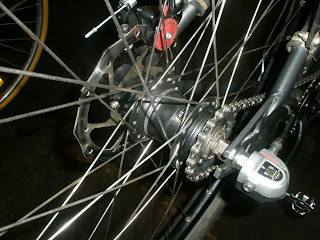
Shimano has been making internally geared hubs for decades and this is one of their newer models. The SG-3D55. It's a 3 speed hub with a disc brake.As in the newer Sturmey Archer hubs, Shimano has simplified things with modular design. If you look closely you can see that some of these parts are rusted out from a harsh Minnesota winter. Though these hubs are relatively low maintenance, if ridden in extreme conditions, moisture can work its way into the hub where it will wreak havoc on the assembly. A new internal assembly and now it's ready for many more miles of happy riding.

Another of Shimano's internally geared hub offerings is the very popular Nexus 7 speed. This one is the SG-7R40, set up for use with a roller brake (not pictured).


As with most internally geared hubs, very little is recommended in the way of maintenance. Get your hub cones adjusted well and properly set up your cassette joint and shift cable, then ride. That being said, don't ignore your hub. You can have the internal assembly removed, cleaned and re-lubed to keep things running smoothly and to avoid unnecessary wear to the expensive parts inside.

Last, but not least, we've got another new hub, this one from Sram. It's the S7, this one has a coaster brake, and it is by far the most complicated hub out of this bunch...


The operation of this hub is just as smooth and simple as the Shimano offerings. Sram uses a modular design as well, but many of the sub assemblies can be broken down to their smallest parts. In practice there is no need to ever take one of these apart to such a degree.

If you are interested in learning more about internally geared hubs, and the bikes they are available on, then stop into our Minnehaha shop. You can test ride bikes with different types of hubs or talk to our service staff about one that you are already riding.